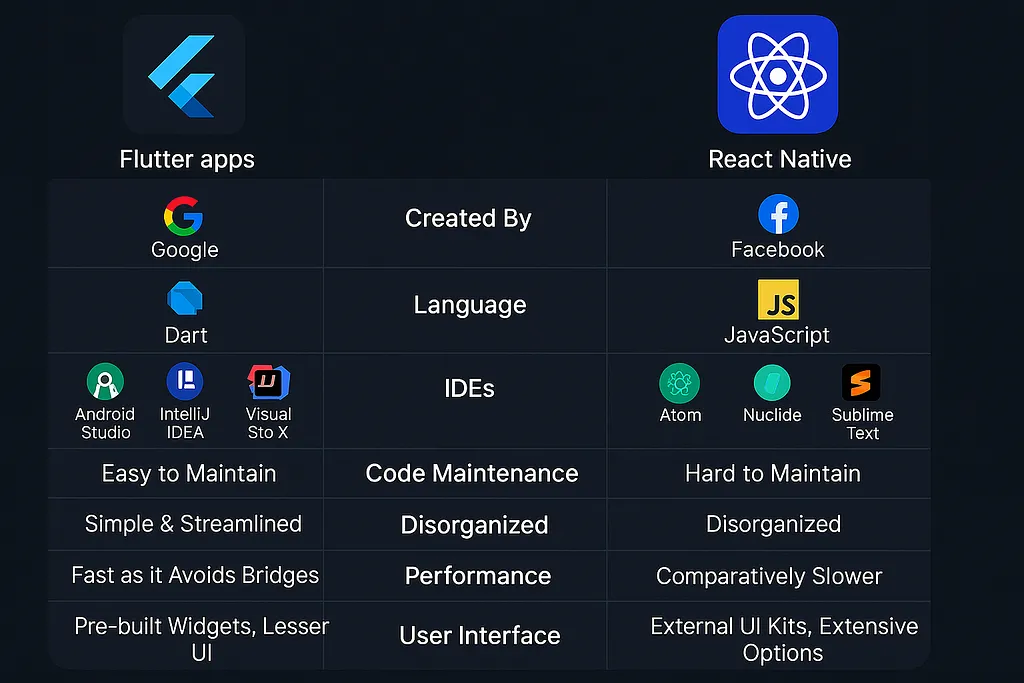
A Realistic and Timely Comparison of the Two Leading Cross-Platform Frameworks
Deciding between React Native and Flutter in 2025 parallels the earlier decision between iOS and Android. Both ecosystems are mature and viable, yet selecting one will have a significant impact on developer experience, application performance, and project timelines. This article examines the most recent versions of each framework as of May 2025 and offers a decision framework based on real-world development considerations rather than subjective preferences or synthetic benchmarks.
New Features in Flutter 3.32
Flutter, Google’s open-source UI framework, has continued to evolve since its launch in 2018. Version 3.32 presents substantial improvements that make Flutter more production-ready than ever.
Most Significant Enhancements:
- Hot Reload for the Web (Experimental): Developers can now benefit from near-instant reload capabilities even on Flutter Web, addressing a long-standing limitation.
- Material 3 Expressive Design Support: Flutter introduces more advanced UI capabilities, including smoother animations and enhanced theme customization.
- AI Integration: Native Firebase AI Logic now enables dynamic recommendations, intelligent chatbot behaviors, and predictive interface rendering.
- Accessibility Enhancements: The introduction of SemanticRoles offers better support for screen readers and assistive technologies.
- DevTools Update: The new Flutter Property Editor improves debugging by allowing real-time fine-tuning and inspection of widget properties.
In 2025, Flutter has matured into a full-fledged UI development framework — robust, reliable, and increasingly popular for production-scale applications.
New Features in React Native 0.79
React Native, maintained by Meta, remains the preferred solution for development teams already familiar with JavaScript and the React ecosystem. Version 0.79 introduces multiple enhancements aimed at developer productivity and runtime performance.
Key Updates:
- Improved Startup Time: Android startup times have been significantly reduced through optimized bundle delivery.
- Hermes Engine Enhancements: Performance gains include lower memory usage and faster JavaScript execution on mid-range devices.
- Simplified iOS Integration: Swift-native modules are easier to register and utilize.
- Expanded Styling Capabilities: Support for mixBlendMode, boxSizing, and other CSS-like properties allows for more flexible layout styling.
- Debugger Modernization: Legacy remote JavaScript debugging has been removed and replaced with more performant alternatives.
React Native remains a strong choice for applications that prioritize quick iteration and broad device compatibility over complete native fidelity.
Flutter vs. React Native: A Feature-by-Feature Comparison
- Programming Language
Flutter: Uses Dart — a modern, fast language optimized for user interface development.
React Native: Uses JavaScript or TypeScript, both of which are widely adopted and familiar to many developers. - 2. User Interface Rendering
Flutter: Uses a custom rendering engine (Skia/Impeller), which ensures consistent design across platforms.
React Native: Renders using native components, providing a look and feel that closely resembles the host platform.
3. Performance
Flutter: Ahead-of-time (AOT) compiled and does not require a JavaScript bridge, resulting in faster performance.
React Native: Performance has improved but remains dependent on the JavaScript runtime.
4. Hot Reload
Both frameworks support hot reload; additionally, Flutter extends this capability to web applications.
5. AI/ML Integration
Flutter: Provides native support for artificial intelligence and machine learning through Firebase AI tools.
React Native: Requires third-party integrations to enable AI/ML functionalities.
6. Community Support
Flutter: Backed by Google and experiencing rapid growth.
React Native: Supported by Meta and characterized by a large, active ecosystem.
7. Styling Capabilities
Flutter: Utilizes Material 3 and a widget-based theming system.
React Native: Employs a CSS-like styling approach using the StyleSheet API.
8. Application Size
Flutter: Tends to produce slightly larger APK files.
React Native: Generates smaller binaries by default.
9. Desktop and Web Support
Flutter: Offers official support for desktop and web platforms.
React Native: Provides experimental desktop support and limited functionality for web applications.
Choosing the Right Framework: A Goal-Based Perspective
Framework selection should be informed by your team’s goals, technology stack, and long-term roadmap.
Select Flutter if:
- You require consistent and polished UI on Android, iOS, and desktop platforms.
- Your development team is willing to adopt Dart or already integrates with Firebase.
- Design control and Material 3 compliance are project priorities.
- Your application needs AI capabilities, offline-first UI logic, or advanced animation features.
Recommended for: Product-centric startups, enterprise-grade UI systems, and applications with deep Firebase integration.
Choose React Native if:
- Your team is already proficient in JavaScript, TypeScript, and the React ecosystem.
- Rapid prototyping or MVP delivery is a key concern.
- Your UI requirements range from basic to moderately complex, with a preference for native aesthetics.
- You plan to leverage the vast JavaScript ecosystem or utilize browser-like logic.
Recommended for: Development agencies, teams transitioning from web to mobile, and projects requiring fast, iterative releases.
Developer Takeaway
Both Flutter and React Native have matured into capable, production-ready frameworks. React Native offers a familiar development model for web-centric teams, while Flutter delivers high-performance, visually consistent applications across multiple platforms.
Ultimately, the optimal choice depends less on abstract feature comparisons and more on alignment with your current tech stack, your team’s learning curve, and your future product roadmap.
Bonus Recommendation: Prototype with a Microfeature
Before committing to either framework for a full-scale project, consider implementing a small but representative feature — such as user onboarding or a profile editor — in both Flutter and React Native. This hands-on approach will provide meaningful insights into workflow efficiency, tooling, and maintainability within your specific context.
Final Word
In 2025, there is no universal “best” framework. However, there is a best fit for your specific development team and product strategy. Select the platform that enables faster iteration, supports clean architectural patterns, and aligns with your long-term goals.